small circles
Meaningful relationships develop through recurring interactions, familiarity, and mutual support.
In Halo you join a small Circle and keep coming back to the same people, instead of shouting into a crowd.
In the app
The thinking behind Halo
Recovery is personal. Connection is human. Technology should respect both.
Halo brings research-informed principles of peer support together with thoughtfully designed technology to help people find their Circle, celebrate progress, and stay connected.
Halo is an iPhone app in early access. This page describes Halo 1.1.0 and our service as they work today. Anything still in progress is labelled.
Recovery rarely happens alone. Some of the strongest evidence in the field points to the same idea: the people around you matter.
A 2020 Cochrane review found high-certainty evidence that clinical programs helping people engage with Alcoholics Anonymous led to more continuous abstinence at 12 months than established treatments such as cognitive behavioral therapy.1
On most other drinking measures these programs performed about as well as other treatments, and they probably reduce healthcare costs.1
Research on AA suggests much of its benefit comes through social change: fewer people who encourage drinking, more people who support recovery, and more confidence staying sober around others.2
In a randomized trial, counseling that helped people build sober social circles was followed by more days abstinent two years later.3
A systematic review found that support from trained peers with lived experience can help people engage with and stay in care. Effects on substance use itself are still uncertain.4
Continuing support after initial treatment has, on average, a modest benefit.5 Support that keeps people actively engaged over a longer period tends to show more consistent results.6
The US National Institute on Alcohol Abuse and Alcoholism describes mutual-support groups as a valuable addition to professional treatment.7
These studies looked at Alcoholics Anonymous, Twelve-Step Facilitation, trained peer-support services and clinical continuing care. None of them studied Halo, and Halo isn’t any of those programs.
We use this research as a compass for design, not as proof that Halo works. Halo is peer support, not treatment, and it doesn’t replace professional care or mutual-help groups. We’ll share findings about Halo only once we’ve measured them, with members’ consent.
How Halo turns what the research suggests into the everyday shape of the app.
Meaningful relationships develop through recurring interactions, familiarity, and mutual support.
In Halo you join a small Circle and keep coming back to the same people, instead of shouting into a crowd.
In the appMembers can begin together, participate in common experiences, and maintain connections over time.
Each cohort is named for the New Moon it began with, and its members answer the same Daily prompt together.
In the appPrivate commitments, sobriety milestones, reflection, and celebrations help members recognize their own journey.
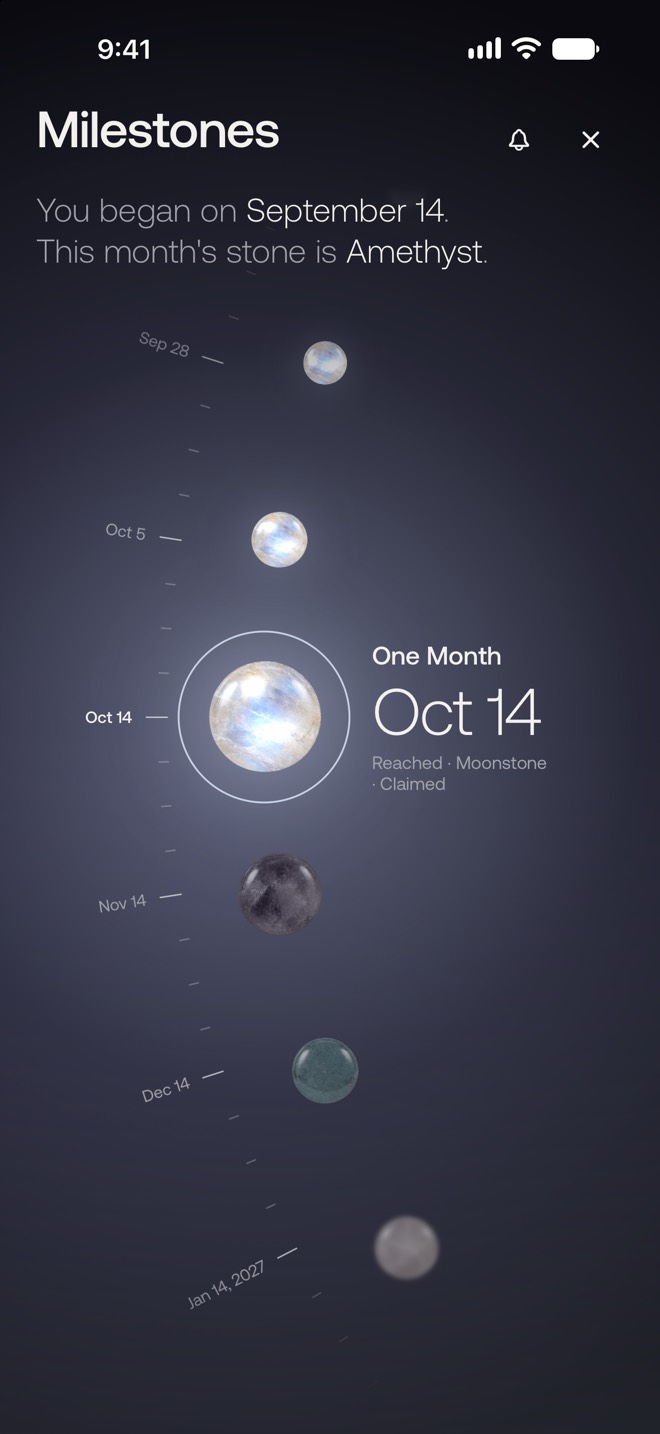
Your start date and journal stay on your iPhone. Milestones are claimed and kept, never earned or lost, and sharing one is your choice.
In the appTechnology can help organize conversations and gatherings, but human connection remains the product.
Today, people do the connecting in Halo. There’s no AI companion and no chatbot. A coordination assistant for your Circle, for things like finding a time to meet, is something we’re exploring. It isn’t in the app.
Exploring, not built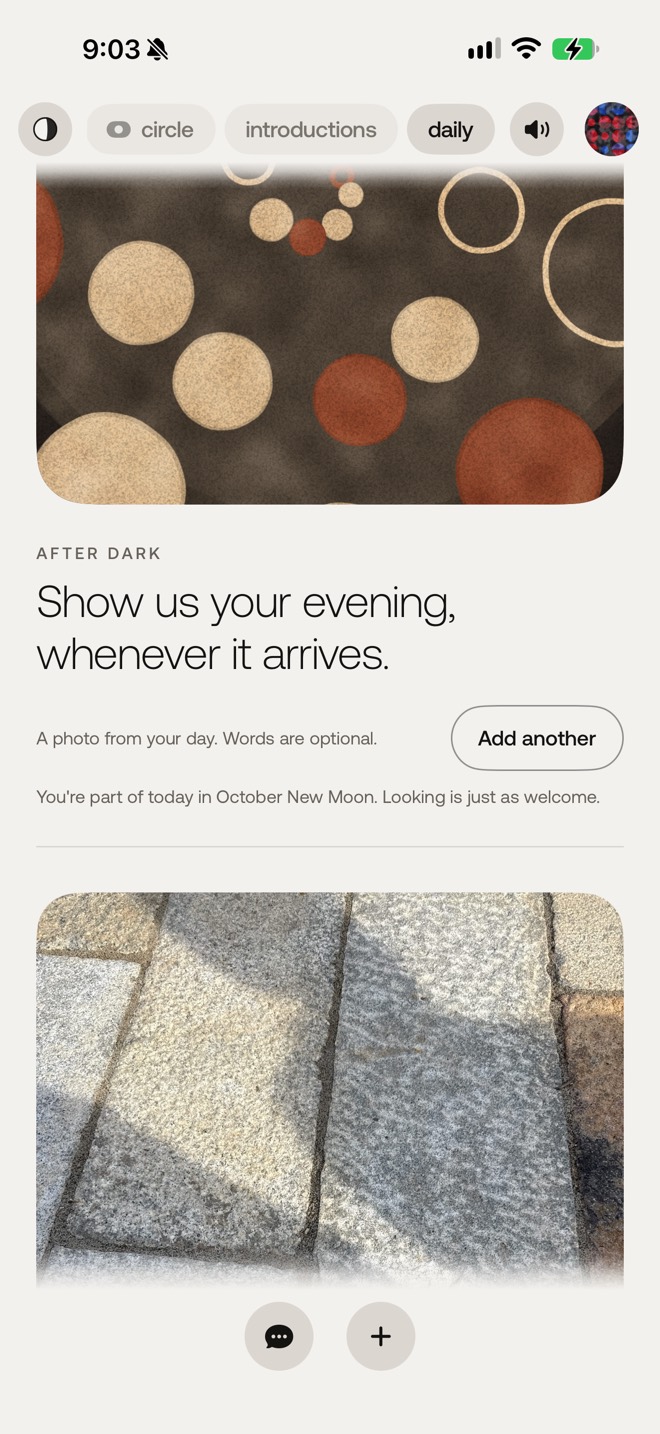
Privacy isn’t a settings page in Halo. It shapes what we build, what we store and what we leave out.
Join your Circle as an anonymous member, without a handle. Halo keeps your participation linked to your account so reports can be acted on and people kept safe.
Your journal, notes and sobriety start date are stored on your iPhone with iOS Data Protection and aren’t uploaded to Halo. Device backups follow your own Apple settings.
Nothing about your progress is shared unless you share it. When you share a milestone, Halo receives the number of days, not your start date.
You don’t have to enter a start date at all. There’s no public counter to keep and nothing to lose for a quiet day.
Lock Halo with Face ID, Touch ID or your passcode, if you choose. The app switcher then shows a plain Halo screen. Screenshots still work, so the people you share with matter too.
Today’s guidance is calculated on your iPhone. What you post to your Circle lives on Halo’s servers, separately, so your Circle can see it.
Messages and Circle posts aren’t end-to-end encrypted. Halo stores them, and moderators can read content that’s reported to them.
Before you share a photo, your iPhone checks it for faces: a safeguard, not a guarantee. Our servers re-encode every shared photo and remove its location and other metadata.
You can delete your account in the app. That erases your profile and what you shared. Some safety records and short-lived backups remain, and your journal stays on your iPhone until you delete the app.
The full details are in Privacy in Halo and the app privacy policy.
Good security is mostly restraint: collect less, expose less, and make the careful path the default. Here’s how Halo is put together.
Halo is written in Swift and SwiftUI using Apple’s own frameworks. There are no third-party SDKs in the app: no ads, no tracking and no outside analytics.
Halo 1.1.0Your sign-in lives in the iOS Keychain, kept to this iPhone and never synced. Your journal is stored with iOS Data Protection.
Halo 1.1.0Your iPhone talks to Halo only over HTTPS, to Halo’s own server, and refuses redirects. Our servers reach the database over verified TLS.
App and serviceSign in with Apple only. Our server checks Apple’s signature and a one-time challenge before it starts a session. Halo 1.1.0 doesn’t ask Apple for your name or email.
App and serviceSession tokens are stored only as one-way hashes and expire after seven days. Your Apple identifier is kept as a keyed one-way code.
ServiceThe live service can’t read database tables directly. Every read and write goes through Halo’s own database functions, which check membership and blocks. Schema changes use a separate role the live service never holds.
ServiceToday’s guidance is calculated on your iPhone from the Moon and planets, so the same inputs always give the same result. It isn’t generated by AI.
Halo 1.1.0Shared photos are stored privately, with no public links. Reminders are scheduled on your iPhone with generic wording, unless you choose to name a milestone.
App and serviceRequests are rate-limited per connection and per account. For that, our database keeps a keyed one-way code of your IP address for minutes. Our hosting provider receives your IP address to deliver the service.
ServiceHalo’s server code doesn’t log message text, photos or personal details. Our hosting platform keeps standard request logs.
ServiceWe don’t claim end-to-end encryption, certificate pinning or HIPAA compliance, because we haven’t built or formally assessed them. When that changes, this page will too.
Halo is human-first by design. There’s no AI companion, no chatbot and no simulated members. People support people.
Halo isn’t a crisis service. If you or someone else is in danger, call 911, or call or text 988 in the US.
Today Halo is an iPhone app in English. That’s where we’re starting, not where we mean to stay.
human first. never alone.
Sources checked 9 November 2026. Research findings describe the programs and services studied, not Halo. Halo offers peer support, not treatment or crisis care; if you’re in crisis in the US, call or text 988.